 Poke Fun Play
Gengar and the Midnight Library
When books begin returning to a closed hilltop library, Mara discovers that its midnight visitor is following a different kind of catalog.
The book on the wrong shelf
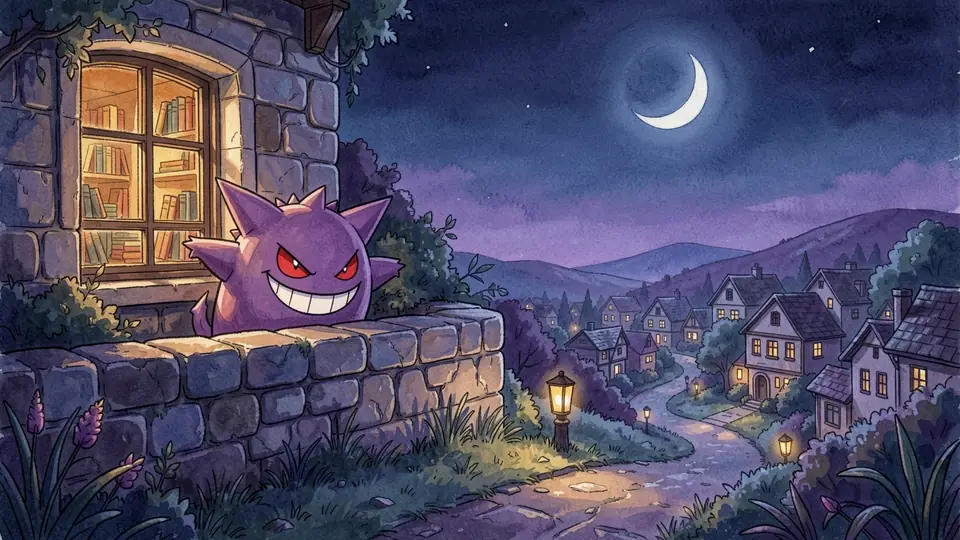
The gardening book was wedged between two atlases of the night sky. Mara noticed it because a pressed yellow flower hung from its pages, bright against the gray dust. She had come to the hilltop library to count broken chairs, not solve a mystery. The village council wanted an inventory before deciding whether the building could become a storeroom. Already she had found nineteen chairs, three umbrellas, and a door that sighed whenever she moved.
She pulled the book free. A neat label inside read, Flowers for a Small Window. Underneath were the names of borrowers, most crossed out. The final name had no return date. Mara checked the gardening shelves near the door. They were empty except for a ceramic watering can. Nobody had borrowed anything here in eleven years, and yesterday, when she had swept this aisle, there had been no flower between the atlases.
Down in the village, people had an explanation. Gengar had been seen on the library wall three nights running. Gengar liked dark places, said the baker. Gengar had a grin suited to trouble, said the council clerk. An old building was exactly where you would expect strange things, said everyone who had never stepped inside it. Mara was not certain a grin counted as evidence, but she took a lantern when she returned that evening.
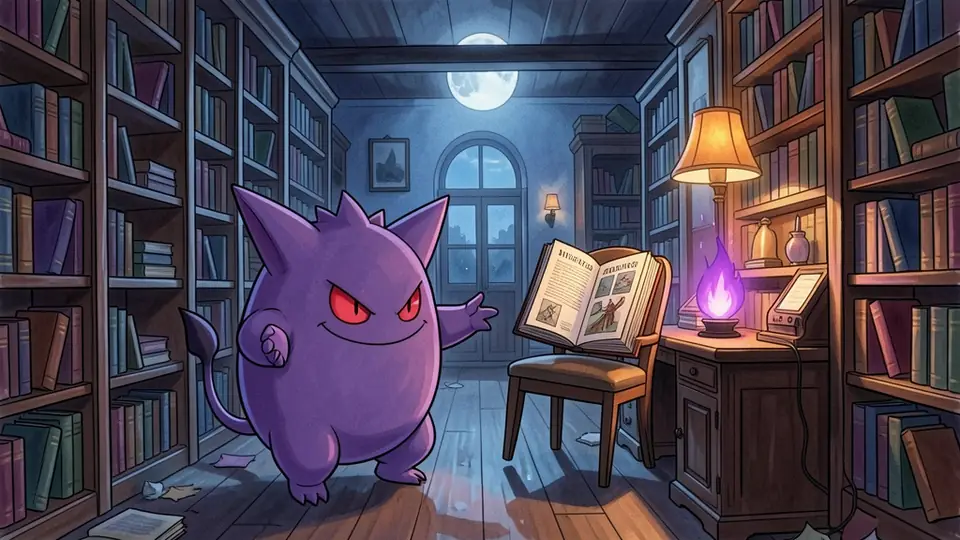
At eleven fifty-eight, the library was as cold and ordinary as it had been all afternoon. Mara sat behind the lending desk with an inventory sheet on her knees. At midnight, a purple flame appeared on the desk. Litwick stood beside the ink bottle, looking pleased with the place it had chosen. Across the room, another light brightened. Then a third. Someone turned a page in an aisle Mara could not see.
A book slid out of the return cupboard. It floated waist-high across the room, opened once as though sniffing the air, and settled on the astronomy shelf. Mara jumped to her feet. Gengar appeared behind the cupboard with its arms spread wide and its familiar grin. Mara raised the lantern. Gengar promptly raised both empty hands, then pointed to the newly returned book with the seriousness of a clerk presenting a receipt.
Noctowl descended through the open roof vent, landed on a reading chair, and looked from Mara to Gengar. It tapped the chair's torn seat with one talon. Gengar shook its head and pointed upward again. Mara followed the gesture. The returned book was a manual of chair repair, balanced beside a chart of distant constellations. Whatever was happening, it seemed an unnecessarily elaborate way to misfile practical instructions.
Mara set down her lantern. Gengar relaxed, although the grin remained. She opened the repair manual and found an old borrowing card tucked inside. The name matched the last borrower in Flowers for a Small Window. On the reverse someone had drawn a tiny square window, a chair, and a star. Mara copied the drawing onto her inventory sheet. For the first time that day, the broken chairs seemed less interesting than the place they had once belonged.
The midnight catalog
By the next evening, Mara had found six more books in unlikely places. A cookbook occupied the geography cupboard. A guide to mending clothes leaned against the poetry collection. Every volume contained a borrowing card with the same little square window. The names differed, but the drawing did not. When Mara asked the council clerk about it, he said he had never noticed pictures on cards and suggested she concentrate on the chairs.
She concentrated on the chairs in a different way. Their undersides were marked with blue paint, each stroke shaped like a star. The same mark appeared on a box of mismatched cups in the kitchen and on a folded curtain behind the map cabinet. The library had once contained something beyond books. Mara took the curtain upstairs, looking for a window that would fit it. All the ordinary rooms had narrow windows. At the end of the corridor stood a locked door.
The door was labeled Store, but the label had been pasted over an older strip of paper. Mara rubbed the dust away without disturbing it. A painted star peeped from one edge. There was no key on the keeper's ring. She could have asked Gengar to slip inside, but when midnight came and she pointed at the lock, it firmly shook its head. Litwick climbed into an empty teacup. Noctowl turned toward the stairs. They had their own order of business.
Tonight the return cupboard supplied a book about coastal boats. Gengar carried it through the wall and emerged beside the poetry shelves. Mara followed, protesting that she had been standing exactly where it passed. Gengar regarded her solemnly, then went around her the long way with a second book. The gesture was so exaggerated that Mara laughed. The little flame in Litwick's teacup bobbed. The library suddenly felt less like a place holding its breath.
The boat book had belonged to a woman named Eda. Mara knew an Eda who ran the bakery and had never mentioned boats. At dawn she visited with the borrowing card. Eda recognized her mother's handwriting immediately. Her mother, she explained, had loved the sea despite never traveling farther than the next valley. On difficult days, she came to the library and read by a broad window, where somebody always had the kettle ready.
That room, Eda remembered, was not arranged by subject. Books went onto three shelves: ones that helped, ones that took you somewhere, and ones that made you laugh. Borrowers drew the star-window mark because the room had no lending desk of its own. When the librarian became too ill to climb the hill, the room closed first. People kept the books they had borrowed. They meant to return them. Meaning to do something could last longer than anyone expected.
Mara looked toward the hill. The books were not wandering into wrong places at random. Someone was trying to restore a room whose rules had disappeared. She asked Eda whether the old librarian was still in the village. Eda nodded and wrapped two buns in paper. Mara took them, along with a new question. How could a library welcome its readers again if the village had forgotten what its welcome looked like?
A room waiting for readers
The old librarian lived above the tailor's shop. Her name was Sela, and the key to the upstairs room lay in a dish beside her front door. She listened to Mara's account without interrupting, even when Mara described the books floating. At that, she smiled into her tea. She remembered Gengar. On winter evenings, it had sat behind the broad-window curtain, startling new visitors until they realized it was keeping the drafts from reaching their feet.
Sela had not known that the books were returning. She thought perhaps people had begun remembering them as the storeroom proposal traveled through the village. The outside return slot still worked, after all. Someone might post a forgotten book through it without climbing the hill in daylight. She gave Mara the key, but not an instruction. The room had never been hers alone. She had simply opened the door and kept opening it until others felt able to come.
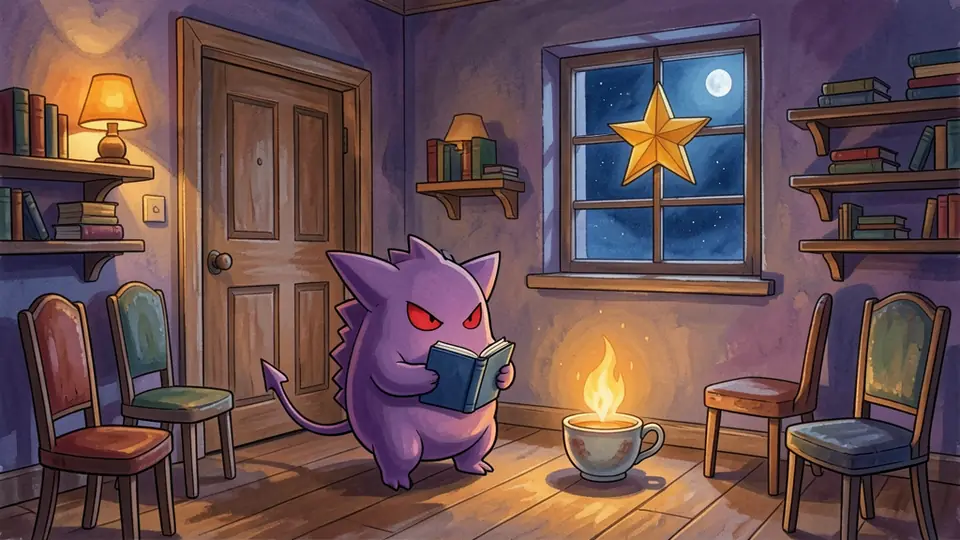
Mara unlocked it that afternoon. Dust stood in the light like fine flour. The three shelves were bare, except for a bowl of smooth stones that readers once used as bookmarks. Through the window, the village looked close enough to hold in one hand. The sill was broad, just as Eda remembered. Mara opened the curtain she had found downstairs. Its faded embroidered stars fitted the hooks perfectly. She did not yet put the books back. She wanted to understand the last part.
At midnight she waited inside the room. Gengar arrived through the wall, carrying the gardening book. It placed the book on the sill rather than a shelf. Noctowl brought the chair-repair manual, gripping it carefully by its cloth spine. Litwick stood beneath the kettle, although Mara had not lit the stove. The three looked expectantly toward the door. Mara glanced at the chair, the broad window, and the empty hooks where cups should hang. The books were instructions as well as memories.
Mara stood beside the window and pictured the floor below. The astronomy shelves lay directly underneath this broad sill. The geography cupboard stood beneath the stove corner. The poetry collection was below the curtain hooks. Gengar had arranged the returns like instructions for the room above, putting each book where its next job waited. The gardening guide belonged at the window; the cooking book belonged at the stove. Mara looked down at the chair manual. Gengar slid a bowl of repair wedges beside her. That instruction was particularly clear.
By three in the morning, Mara had repaired two chairs. Gengar held the seats while she tapped each wedge home, wincing theatrically whenever her hammer hit its fingers without consequence. Noctowl fetched the right-size pieces after examining them with grave precision. Litwick's flame lit the pages, far from the curtain and dry paper. Nobody said much. The work itself felt like conversation. Mara was glad she had not brought a list of people to blame.
Near dawn, a soft scrape came from downstairs. Mara hurried to the return cupboard and found one final book. It was not overdue. Its pages were blank, and someone had drawn a blue star on the cover. Inside was a note in Sela's hand: For whatever comes next. Mara carried it upstairs. Gengar stepped aside to let her pass through the doorway this time. The room had enough chairs now, but it still needed its first new readers.
Daytime hours
Mara went down the hill with sawdust on her sleeves and found Eda opening the bakery. She asked for a kettle and received one, along with a basket of rolls and a warning that the handle grew hot. At the tailor's shop she collected Sela, who declined an arm until they reached the steepest part of the path. Behind them came a gardener carrying two pots and a carpenter curious about the supposedly ruined chairs. News traveled faster downhill, but it could travel uphill too.
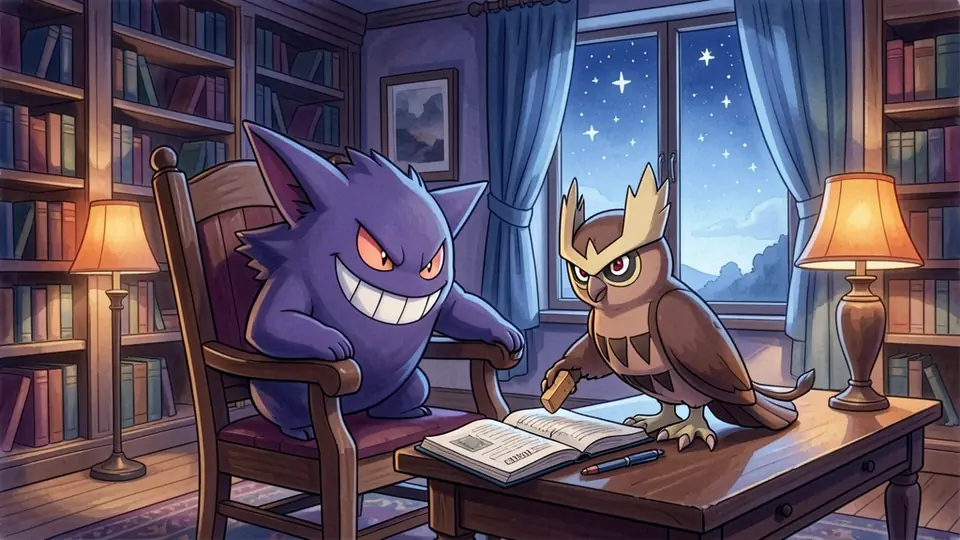
Gengar heard their footsteps and retreated behind the curtain. Mara saw its round silhouette through the faded cloth. She did not call it out. Sela took the chair nearest the window and said, to the room rather than anyone in particular, that drafts had always been troublesome there. After a moment, Gengar's fingers curled around the curtain's edge. The baker set a roll on the sill. Noctowl closed its eyes against the brightening light, looking satisfied and considerably older than the occasion required.
The council clerk arrived last with the inventory forms. He looked at the kettle, the mended chairs, and the three shelves. Mara expected an argument about the storeroom proposal. Instead, he asked where biographies should go. Sela considered the question. A biography could help, take you somewhere, or make you laugh, she said. The reader might decide. The clerk looked uncomfortable with this arrangement, then found a funny childhood recollection in a returned volume and began turning its pages.
Mara placed the blank book on the table. In its first page she wrote the room's opening hours, including midnight on clear evenings for readers who preferred quiet. Below that, people added the jobs they could do: carry water, check the stove, mend curtains, bring flowers. There was no single keeper's name at the top. Sela added only a small star in the margin. Eda wrote that she could bring rolls on Thursdays, provided nobody expected every roll to look identical.
Nobody pretended that the rest of the library was repaired. Rain still came through the roof above the history aisle, and seventeen chairs needed attention. The council agreed to postpone its decision while the village made a proper plan. That was less dramatic than reversing everything at once, but Mara trusted it more. The new room would have to be kept warm by ordinary effort as well as strange visitors. Gengar could not repair a roof just by grinning beneath it.
Before she left, Mara returned the gardening book to a shelf marked by a smooth green stone. It was a place for books that helped. Beside it she set the chair manual. The boat book went on another shelf, ready to take someone somewhere. There were no labels yet. The clerk offered to write some, if people thought that would be useful. Gengar selected a thin book of jokes and put it firmly on the third shelf, its expression almost too innocent.
That evening, Mara climbed the hill again. She no longer needed her lantern. Warm light reached all the way to the gate, where someone had cleared the weeds from the path. Inside, the kettle murmured. Beyond the broad window the village lights were coming on, one by one. When midnight arrived, a book moved softly across the room. Mara looked up, smiled, and made space on the table. This time she did not ask whether it was on the wrong shelf.
An original fan-created story by the Poke Fun Play editorial team. Illustrations generated for this adventure.
Featured Pokémon
 Gengar
 Litwick
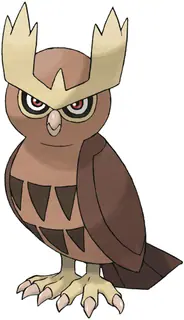 Noctowl
Keep exploring
Related stories
 Mystery
Joltik and the Silent Power Station
The station's machines are healthy, but its lights keep going out. Joltik follows a tiny repeated signal into a control room everyone else has stopped noticing.
Read story → Mystery
Mudkip and the Missing Tide
The sea is rising, but the beach pools remain strangely empty. Mudkip follows a trail of bubbles beneath the sand to discover where their water has gone.
Read story → Mystery
Phantump’s Paper Forest
A trail of folded leaves leads Phantump to a closed workshop, where a forgotten promise needs a different way home.
Read story →Related retailers
Coloring books on Amazon · Pokémon cards on TCGplayer
Paid links. As an Amazon Associate I earn from qualifying purchases. We may earn a commission from purchases through our TCGplayer links.