 Poke Fun Play
Rowlet and the Clocktower Garden
A hidden garden above the city has one small guardian. When the roof must be repaired, Rowlet needs a plan that can protect more than a patch of green.
A roof nobody counted
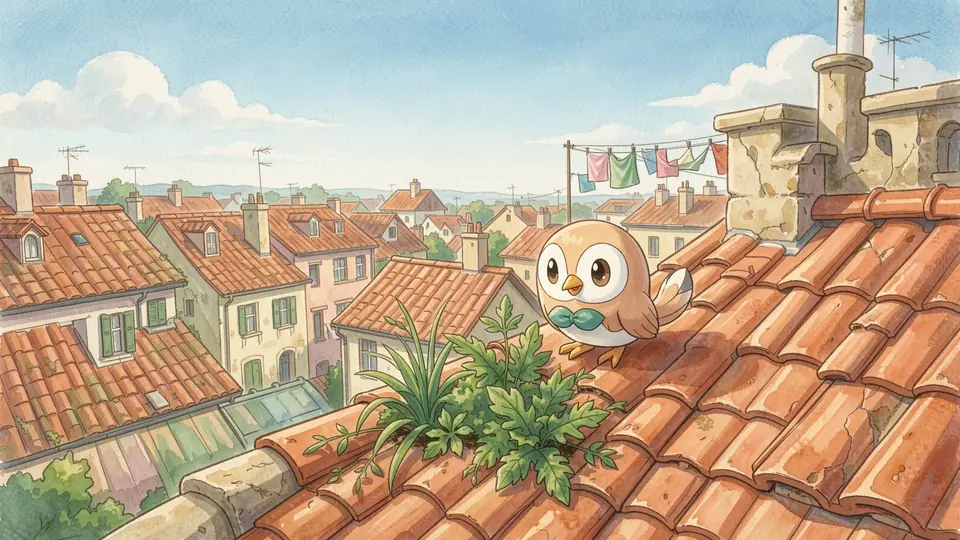
Every morning, Rowlet counted the city by its openings. First came the bakery shutter, with a warm cloud behind it. Then the laundry windows. Then the narrow skylight through which the clockkeeper pushed his head to ask whether it would rain. Rowlet never answered. He had more important counting to do.
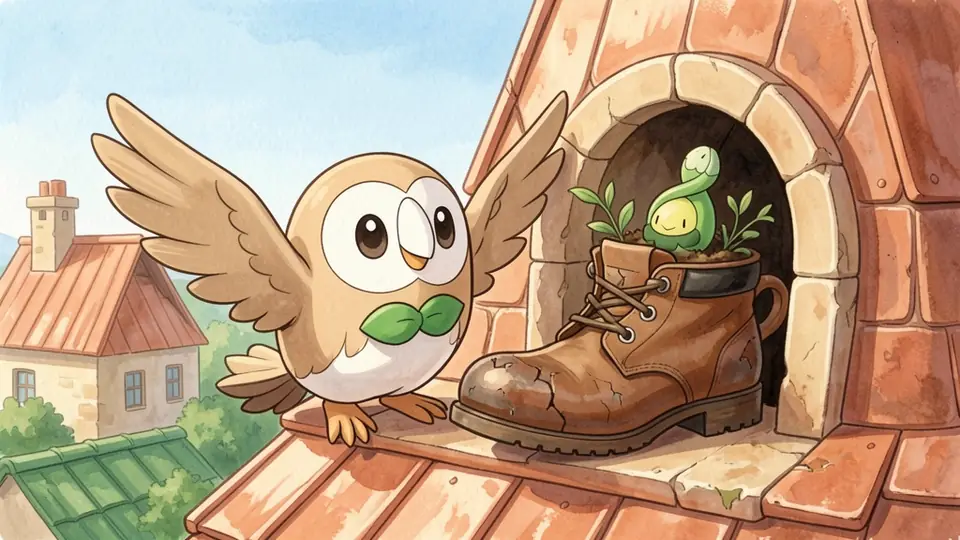
There were seventeen green shoots in the gutter beside the clocktower dome. There were four pots, although nobody had put them there: a cracked teacup, half a drainpipe, a chimney cap, and a boot with no sole. A Budew lived inside the boot. Rowlet had discovered the garden while chasing a moth one evening, and had stayed until the city became something he watched from above.
The clockkeeper's granddaughter, Lena, found him on a Tuesday. She was carrying a brush and a bucket up the final ladder, sent to clear leaves from the roof drain. When she lifted the hatch, Rowlet spread both wings across the gutter. Budew ducked beneath a leaf. Lena stopped with her chin level with the tiles. 'Oh,' she said. 'This is already somebody's roof.'
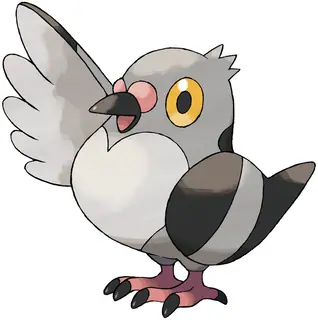
She finished her cleaning very carefully. The leaves she removed were brown and loose; the plants she left were green and rooted. At lunch she returned with a saucer of water. Rowlet permitted this. A Pidove landed on the dome, tilted her head, and stole the largest crumb from Lena's sandwich. Permission, apparently, was not essential to everyone.
Lena came back the next afternoon with a notebook. She drew the boot and the teacup and the gutter, then labeled them with names she invented because she did not know the flowers. Rowlet liked that she put Budew on the drawing. People walking below seemed to believe a tower was only its clock face. From their pavement, they could not see how many small lives fitted behind the hands.
On Friday, the tower acquired a fence at its base. A notice appeared beside the door. Lena read it aloud: the roof was leaking, the copper seams needed replacing, and scaffolding would go up on Monday. Her grandfather had set buckets beneath the clock mechanism after the last rain. If the beams stayed wet, the tower would have to close.
Rowlet listened from the hatch rim. He understood neither copper seams nor closure, but he understood the broad brush Lena had brought and the word clear. Her notebook drawing showed a garden. The roof plan pinned downstairs showed a blank rectangle in precisely the same place. The adults had measured the tower carefully, and still, somehow, they had missed an entire world.
The problem with keeping everything
Monday arrived with hammers, cheerful voices, and a yellow pulley. Rowlet stood on the boot and made himself as round as possible. A roofer named Mara climbed through the hatch, saw him, and sat down on a dry tile. She did not wave a tool or chase him away. She pointed instead to a dark stain beside the gutter, where water had worked beneath the copper.
'We have to mend that,' she told Lena. 'And this drain has to stay open.' Lena opened her notebook. Mara looked at every drawing, including Pidove's stolen sandwich, but shook her head when Lena asked whether the workers could simply repair around the plants. The roots had pushed beneath a lifted seam. Leaving everything exactly as it was would bring the leak back.
Rowlet inspected the stain himself. Water smelled different there, old and trapped. The garden had survived because the gutter caught rain, but the same rain was finding its way into the tower. He nudged the boot toward a sunnier tile. It did not move. The roots had grown through its missing sole and joined the neighboring shoots. Budew shivered as the boot tilted.
For the first time, Lena closed her notebook without drawing. 'If I move the pots downstairs,' she asked, 'will that be enough?' Pidove answered by landing on the chimney cap. A breeze crossed the roof, carrying the smell of the bakery and dust from the square. Downstairs there was pavement, a narrow doorway, and a storeroom without windows. Rowlet looked from those places back to the sky.
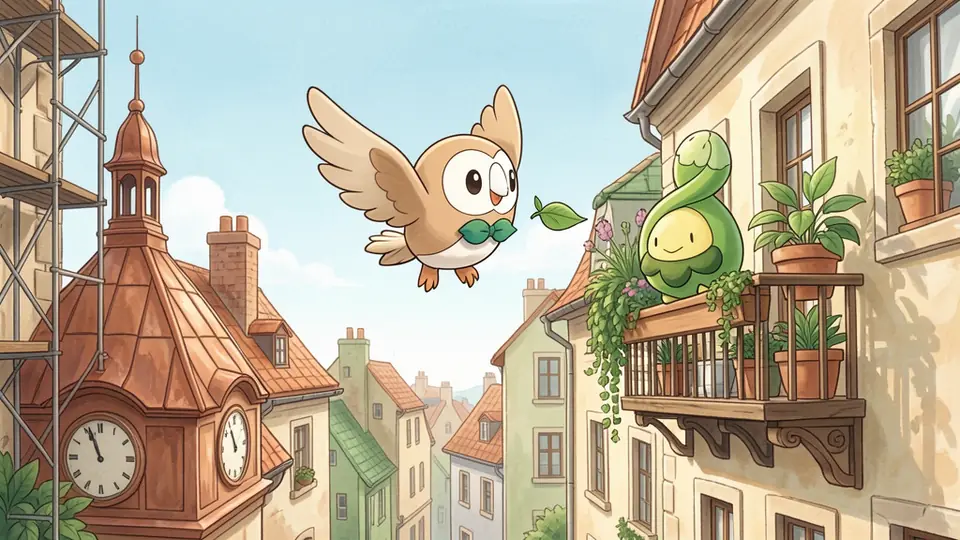
Mara proposed temporary boxes on the neighboring balcony, where the clockkeeper's sister grew herbs. The balcony had shade in the afternoon and a rail high enough to keep soil from blowing away. Budew could stay there during the work. Lena agreed too quickly, then looked ashamed. Rowlet turned his back. She could not tell whether he was angry with her or with the whole complicated Monday.
Moving day took longer than anyone expected. Mara loosened the soil while Lena held the boot steady. They kept each plant's roots damp and lifted them in small clumps. Rowlet ferried light leaves across the alley; Pidove carried none, but followed every journey with great seriousness. By late afternoon, the balcony contained four pots and a fifth box filled with the garden's smallest shoots.
The tower roof looked enormous without them. Rowlet stayed beside the hatch until sunset, staring at the clean strip of gutter. Lena sat a respectful distance away. 'Temporary means we have to think of what comes next,' she said. Below, the clock struck seven. Rowlet heard the mechanism safely ticking under the tiles, and disliked how reasonable it sounded.
A garden with room underneath
Lena's first design was a magnificent roof forest. It included a pond, six trees, a bridge, and somewhere to sit with a sandwich. Her grandfather admired the drawing before explaining that the roof would not admire the weight. Her second design was a single flowerpot nailed to the dome. Mara explained that making holes in the newly repaired copper would rather spoil the point of repairing it.
The third design began with a question. Lena asked Mara what a roof garden could stand on if it could not stand in the gutter. Mara fetched two short rails and a shallow tray. The rails spread the load over strong parts of the roof. The tray lifted the roots away from the copper. Beneath it, there would be space for water to reach the clear drain.
They made a cardboard model on the balcony table. Rowlet hopped from tray to rail and rearranged a paper flower with his beak. Pidove tugged the flower out. Lena drew a sheltered side, lower than the dome and away from the worst wind, then checked where its shadow fell through the afternoon. Budew explored the model with solemn little steps and settled in its sunniest corner.
Before the new bed could be installed, a windy morning tested every promise. A gust hit the balcony just as Lena carried the empty teacup outside. The cup rolled; she caught it against the rail. Behind her, the box of seedlings lifted at one corner. Rowlet darted down onto it, spreading his wings, but another gust sent loose soil racing across the tabletop.
Pidove dropped beside him. She pressed herself against the opposite corner while Lena slid the box to the sheltered wall. Budew clung to a stem, swaying but safe. Nobody cheered. They stood very still until the gust had gone, and listened to the scaffolding whistle across the alley. The model had shown where the sun went. It had shown nothing about how wind could reach beneath a tray.
Mara added a low protective rim and secured the real bed to its support rails. She checked the fixings twice. Lena removed the pretty, tall corner post she had drawn, because it would catch more wind than any plant needed. The final bed looked smaller than her roof forest. It also looked like something that could remain on a roof during a weather forecast nobody particularly liked.
When it was ready, Rowlet inspected the empty space underneath. Rain could pass through without soaking the beams. Roots would have room without prying up copper. A little entrance in the sheltered rim allowed Budew to come and go. Lena placed the old boot in the corner; its sole would no longer reach the tower. Rowlet touched the boot with his beak, then turned toward the waiting plants.

The eighth opening
The garden returned on a Thursday. Mara carried the heavy soil, Lena carried the four familiar pots, and Rowlet escorted every trip with such close attention that everyone had to pause for him on the ladder. Pidove found the new rim acceptable immediately. She landed on it, shook out her feathers, and watched Budew discover that its boot now stood beside a marigold rather than inside a leaking gutter.
The repaired roof shone with patches of fresh copper. Those patches would darken with time, Mara said; old and new would eventually look as though they belonged together. Lena thought the same might happen to the garden. Its straight tray seemed terribly neat around the teacup and the crooked chimney cap. But once the stems leaned into each other, the neatness was harder to see.
The clockkeeper brought up a watering can. He had agreed to check the bed every morning when he wound the mechanism, and to clear the drain after windy weather. Lena would record which plants survived each season. Mara left a small inspection gap beneath the tray and showed them how to look for standing water without disturbing the roots. There was no ceremony. There were jobs, and people who had accepted them.
A week later, rain put a soft gray lid over the city. Rowlet sheltered beside the boot. Water slipped between the leaves, through the drainage holes, and down the open gutter. In the clock room below, the old buckets remained dry. Lena climbed up after school with wet hair and a triumphant grin. She checked the drain first. Rowlet liked her better for that than for the grin.
The smallest shoot flowered in late summer. Nobody had planted it, and nobody was sure what it was called. It opened white petals against the darkening copper and lasted three days. Lena drew all three in her notebook: first opening, full flower, folded petals. Beside the last drawing she wrote that small things were worth noticing even when they did not last long enough for a photograph.
By autumn, the clocktower had acquired a new morning habit. After the bakery shutter, the laundry windows, and the skylight, the roof hatch opened. Sometimes Lena appeared. Sometimes her grandfather did. Once Mara visited with a replacement fixing and stayed to eat her lunch where she could see the sky. They never stepped straight into the garden. They always looked for its residents first.
Rowlet continued his counting. There were seventeen shoots again, although they were different shoots. There were still four pots, a Budew in a boot, and a Pidove who could not be trusted beside a sandwich. The city below was growing and changing in ways he could not prevent. Up here, above its busy windows, one of the changes had made room for him. He tucked his head into his feathers while the clock struck the hour.
An original fan-created story by the Poke Fun Play editorial team. Illustrations generated for this adventure.
Featured Pokémon
 Rowlet
 Budew
 Pidove
Keep exploring
Related stories
 Cozy
Dedenne and the Thread Bridge
A rainy-day message line links two workshops across a courtyard. Dedenne wants to send something special, but the bridge has room for a kinder sort of contribution than anyone planned.
Read story → Cozy
Mimikyu at the Costume Parade
Mimikyu wants to join the lantern parade, but its traditional final reveal makes belonging feel risky. A sudden shower gives the neighbors a reason to rethink the tradition.
Read story → Cozy
The Snorlax Sunrise Club
The hill has one officially perfect place to watch sunrise. Snorlax has chosen it for sleeping, and the club is preparing a complaint.
Read story →Related retailers
Coloring books on Amazon · Pokémon cards on TCGplayer
Paid links. As an Amazon Associate I earn from qualifying purchases. We may earn a commission from purchases through our TCGplayer links.