 Poke Fun Play
The Sandshrew City Beneath the Dunes
A storm uncovers the roof of a forgotten desert waystation. Sandshrew discovers that its greatest treasure is something meant to keep moving.
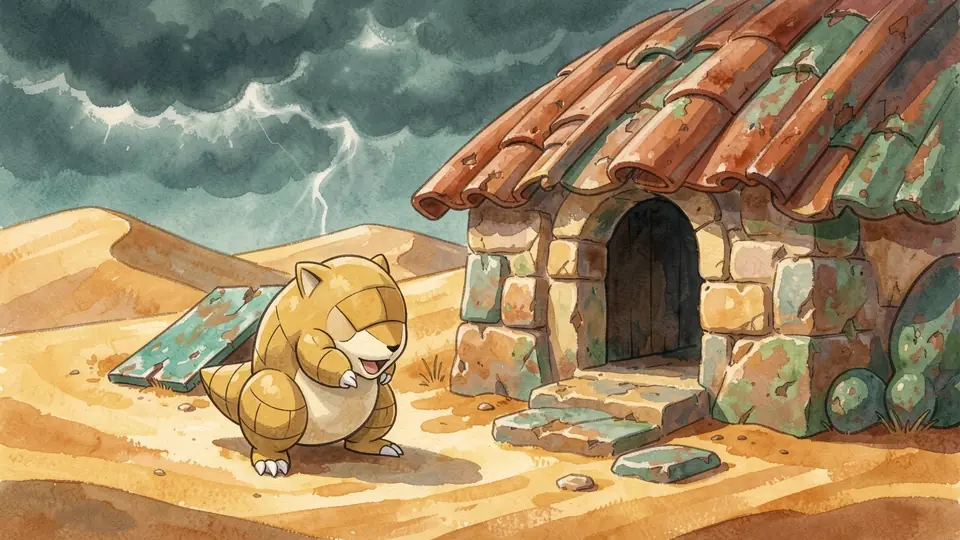
The roof that appeared overnight
After the storm, the desert had exchanged its landmarks. The small dune beside Cacnea's resting place had moved east. The ridge where Trapinch dug its pit had become a hollow. Sandshrew's favorite basking stone was gone, replaced by an entirely unfamiliar curve of red clay. Sandshrew climbed the curve, scratched away a little loose sand, and found neat tiles fitted together. The desert had not made those tiles during the night.
Cacnea stood at the edge of the hollow, looking toward the narrow line of palms beyond the dunes. The oasis had been shrinking for weeks. Its shallow pool no longer reached the roots that once lined it, and the last clean water stood in the deepest patch. A storm could move mountains of sand without bringing a drop of rain. Cacnea had hoped this one might clear the old seep beside the palms. Instead it had provided a roof.
Trapinch emerged from a safe distance away, sand clinging to its broad orange head. It investigated the exposed tiles and found a gap beneath their lower edge. Cool air came through, smelling of stone rather than open desert. Sandshrew followed the roof downhill to a half-buried doorway. A blue tile above the door showed a bird standing beside a bowl. The bowl held three curved lines. Water, perhaps, or wind. The bird appeared uninterested in explaining.
Sandshrew cleared the loose sand immediately outside the doorway, leaving the heavy stones untouched. Behind the entrance lay a short passage sloping gently downward. Its floor was dry and its roof broad, supported by walls still firmly in place. Light reached the first chamber through a crack near the tiles. Sandshrew stepped only where it could see the ground. Trapinch remained at the doorway, attentive to shifting sand. Cacnea waited outside where the route back to the oasis remained visible.
The chamber contained stone benches, a low table, and a shallow basin beneath the bird tile's larger twin. No bright hoard waited in a chest. There were pottery fragments, a wooden frame turned almost to dust, and faint colored shapes on the walls. Sandshrew brushed one shape with the soft edge of a paw. Lines connected squares, circles, and little bowls. It looked less like a picture of the sky than a map of rooms and channels beneath the dunes.
A second passage opened into a smaller court. Sandshrew stopped at its threshold; the ceiling farther in had partly fallen. Through the intact entrance it could see doorways grouped around a central well. The waystation was larger than the first chamber suggested, a little buried city built for travelers crossing the empty land. Perhaps the bowls marked places to drink. Perhaps the bird was pointing toward a route. Sandshrew returned to the basin and listened. Somewhere below its dry stone lip, water made one quiet drop.
Outside, Trapinch shifted closer to the safe edge of the doorway. The wind had begun filling its old pit again. Cacnea watched the horizon, where a pale brown line was rising. The first storm had uncovered a question. A second was already preparing to cover it before anyone could finish the answer.
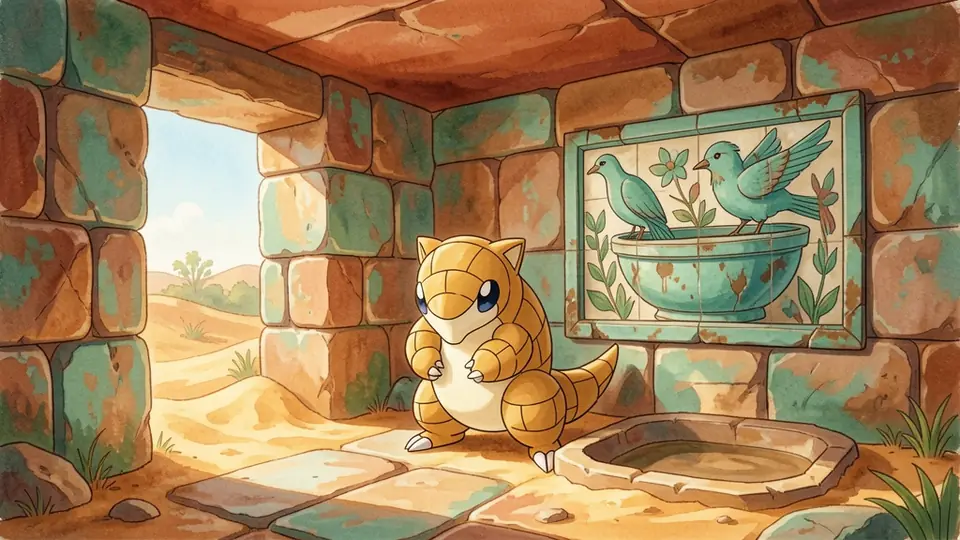
The map that carried water
Sandshrew followed the dropping sound to a narrow inspection opening beside the basin. Beneath it lay a covered channel, built from smooth stone slabs. A trickle moved along the bottom, then vanished into sand packed tightly at the next bend. The channel had not run dry. It had been blocked. Sandshrew returned to the wall map and studied the three curved lines inside each bowl. The lines were water after all, and the circles showed places where it had once risen to the surface.
The nearest circle sat beside a drawing of three palms. Sandshrew remembered the oasis. If the covered channel led there, it might explain why the seep had faded without any obvious change aboveground. It tapped the inspection opening, then beckoned to Trapinch. The broad-headed Pokémon could shift sand efficiently, but Sandshrew would not ask it to dig beneath unsupported walls. They chose the intact access trough near the entrance, where a removable flat cover had already slipped aside.
Trapinch drew loose sand away from the trough's outer edge. Sandshrew lifted small pieces into a pile outside, not into another chamber where they might cause a second blockage. The water's thread grew a little wider. Cacnea brought a dry palm frond from the surface; its stiff central stem could reach the bend without anybody crawling inside. Sandshrew pushed it gently into the packed sand. A few grains broke free, followed by one old ceramic shard lodged like a wedge.
The shard carried part of the same turquoise bird. Sandshrew lifted it carefully and held it toward the light. It was beautiful, brighter than most things the desert allowed to stay bright. For a moment it wanted to keep the piece. Then it saw where the shard had come from: a broken lining tile beside the bend. Another piece remained in place, sharp enough to catch debris again. The map was not the only thing needing attention. The channel's old surface had to be made smooth enough to work.
They could not rebuild the entire passage. Sandshrew knew that from the collapsed court and from how little time the wind would allow. It selected a flat fallen tile from the entry floor, one no longer attached to anything, and tested it against the accessible break. The tile would lie across the rough edge without narrowing the watercourse too much. Trapinch held the surrounding sand steady while Sandshrew settled it in place. The trickle slipped beneath it and continued toward the next covered section.
Nothing dramatic happened at the oasis. Cacnea checked, returned, and shook its round head. The seep remained dry. Sandshrew looked at the map again. Between their chamber and the palms stood a dark square, different from the circles and bowls. Beside the basin, a low stone handle matched that square. It was partly buried and had not moved when Sandshrew first touched it. The channel might be clear enough now, but something farther along was still holding back the water.
Wind whispered across the roof crack. Fine sand sifted into the chamber, making the sunbeam visible. Trapinch raised its head toward the doorway. Cacnea moved to the entrance, where its shadow now stretched toward the brown line on the horizon. The little buried city had more rooms than they could explore. They would have to choose the useful question and leave the rest alone.
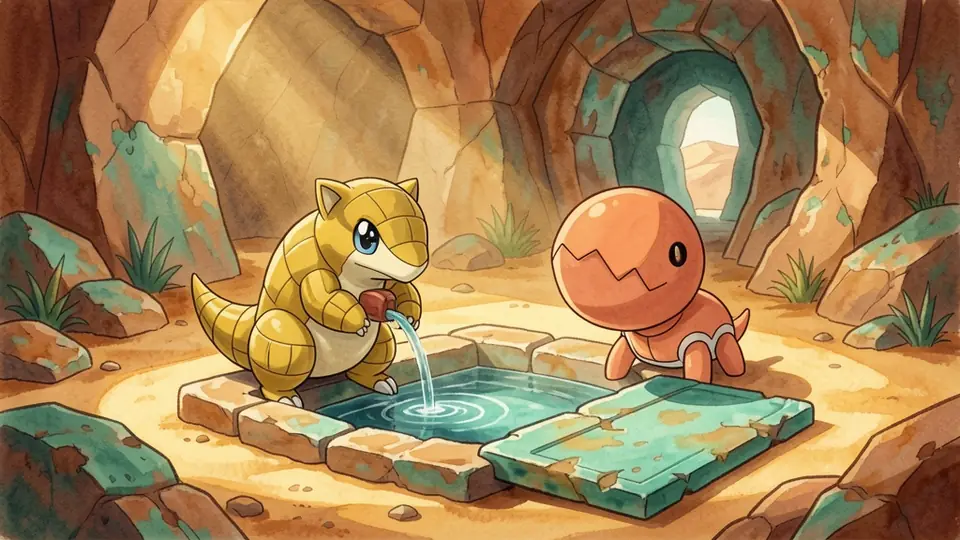
What could be left open
The handle controlled an old sliding gate inside the channel. Sandshrew cleared sand from its base and found two notches in the surrounding stone. One held the gate low, keeping the water in the waystation's storage cistern. The other would release it toward the palms. Sandshrew tugged the handle upward. It moved a little and stopped. Years of grit had settled in the track. Pulling harder might break something they had no way to mend.
Trapinch could reach the outside end of the track through the open access trough. It loosened the packed grains from that end while Sandshrew brushed the exposed groove above. The handle shifted another small distance. Behind the wall, water sounded deeper now, a soft hollow movement rather than a drop. The cistern was holding more than they had guessed. Cacnea remained outside, checking the route to the oasis and warning them whenever the gusts strengthened.
One gust sent a shower of sand through the doorway. The chamber dimmed as airborne dust crossed the roof crack. Trapinch backed out of the trough immediately. Sandshrew followed it to the entrance, where the storm's leading edge had become a low brown wall. There was time to leave safely. There might also be time for one last useful adjustment, but not for exploring the court, collecting pottery, or arguing with the desert's pace.
Sandshrew looked at the blue bird shard still resting beside the basin. It wanted to carry a visible proof of the city back into the daylight. Taking that proof would occupy the paw it needed for the handle. It set the shard gently on the bench where the next visitor might find it. Then it returned to the cleared groove and used the stiff palm stem as a small lever. Trapinch stayed at the doorway, not beneath the roof, while Cacnea watched the safe surface route.
The handle rose into its upper notch. Water moved through the channel with a sound like a long breath. Sandshrew tested the notch lightly; it held. The gate did not need a Pokémon standing beside it forever. That mattered. It left the lever clear of the flow and replaced the accessible trough cover as well as it could, so fresh windblown sand would be less likely to pour straight into the repaired bend. Then it backed out, taking nothing from the bench.
They crossed to the oasis before the main dust reached them. Cacnea led between low dunes rather than over their shifting crests. Trapinch followed the familiar firm ground near old roots. Sandshrew kept the other two in sight, its curiosity finally smaller than its need to arrive together. Behind them the roof disappeared in stages: first the blue tile, then the red curve, then the doorway. The desert closed without a slam, using millions of tiny grains.
At the palms, the seep remained dry for a long moment. Sandshrew sat down, exhausted, and considered whether the whole adventure had been a misunderstanding. Then a dark line spread beneath a root. One bead of water rose, another followed, and a thin clear thread reached the old pool. Cacnea moved aside so its shadow would not hide it. The city had vanished. Its most useful part had found a way out.
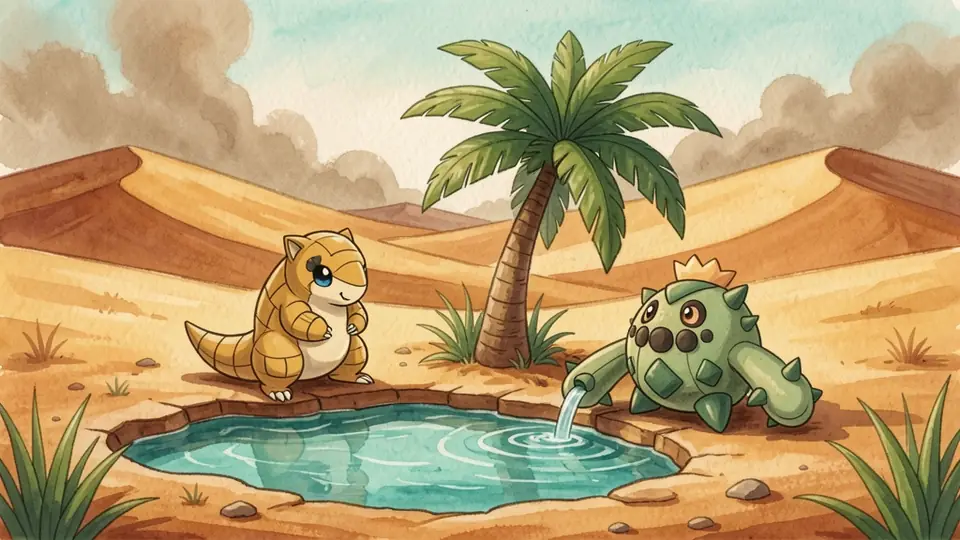
A city that could still do its work
The second storm passed without uncovering anything grand. By morning the dunes had exchanged landmarks again, and the old roof lay beneath a smooth slope that looked untouched. The oasis pool had grown only a little. Water moved slowly through the buried passage, as it had probably always done. That small increase was enough to wet the roots along its edge. Cacnea stood beside them, still as a watchful green post, while Trapinch inspected the new sand beyond the shade.
Sandshrew tried to trace the city's position from the surface. It remembered the roof curve, the doorway, the three palms on the map. Yet the dunes made distances uncertain. It could not simply dig straight down and expect every ceiling to remain safe. Instead it scratched a rough plan onto a flat patch of firm ground near the oasis, marking the approximate direction and the places it had not entered. A passing desert surveyor noticed the drawing later and copied it without declaring that every line was exact.
The surveyor arranged a careful inspection when conditions allowed. She found parts of the old route beneath the sand and confirmed that the water channel continued toward a natural underground seep. The waystation had guided that water rather than created it. Its cistern stored a little for travelers; its overflow fed the palms. She recorded the accessible structures, marked unsafe sections, and left most of the site covered, protected from casual disturbance and another season's wind.
Sandshrew watched from the oasis while the team worked. It did not need to own the blue bird shard to know where it belonged. The surveyor found it on the entry bench and photographed it in place before making a record. She showed Sandshrew the picture afterward. The bird was still incomplete, its beak missing, its bowl cracked. It looked more interesting that way: not a perfect treasure invented for discovery, but a small surviving part of somebody else's useful work.
As the pool steadied, visiting Pokémon returned to its shade. Cacnea no longer had to stand beside the last deep patch. Trapinch found a good new digging place well away from the water's edge. Sandshrew discovered a basking stone near the palms, smoother than the one the first storm had buried. Sometimes it listened to the faint flow beneath the roots and imagined the little city below, dark chambers connected by a moving thread nobody aboveground could see.
The map on the wall had shown bowls, not crowns. Sandshrew kept thinking about that. Whoever built the waystation had cared that a traveler could arrive thirsty and leave with enough water to continue. The stone benches, the shade, the buried cistern: none needed to be magnificent to matter. A city could do one kind of work after its people had gone, if someone noticed the blocked bend and chose to clear it without carrying everything away.
When the next wind rose, Sandshrew curled beside its new stone. The dunes shifted, the palms rustled, and Cacnea's shadow stretched across the pool. Somewhere beneath the sand, water followed the old route through a gate resting in its upper notch. The bird tile remained where it had been left, incomplete and patient. Sandshrew closed its eyes, keeping a city in memory and leaving its best treasure free to move.
An original fan-created story by the Poke Fun Play editorial team. Illustrations generated for this adventure.
Featured Pokémon
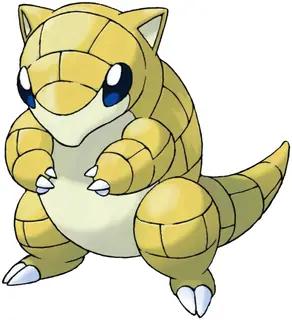 Sandshrew
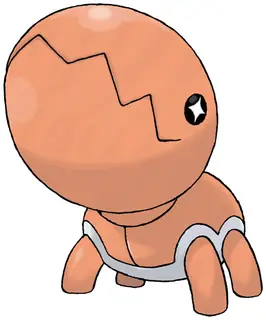 Trapinch
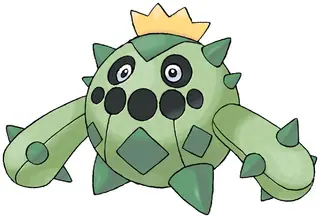 Cacnea
Keep exploring
Related stories
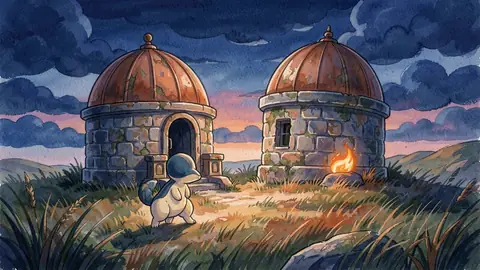 Exploration
Cyndaquil and the Old Observatory
Seeking shelter from a hilltop wind, Cyndaquil wakes an old instrument that has been waiting a century for the right patch of sky.
Read story → Exploration
Eevee and the Road of Eight Lanterns
Eight lantern paths offer Eevee eight exciting possibilities, until a night of exploration reveals that a future does not have to be chosen before breakfast.
Read story → Exploration
The Finizen Beyond the Breakwater
Beyond the harbor wall, Finizen discovers that the open sea moves in patterns a fast swimmer cannot simply outrun.
Read story →Related retailers
Coloring books on Amazon · Pokémon cards on TCGplayer
Paid links. As an Amazon Associate I earn from qualifying purchases. We may earn a commission from purchases through our TCGplayer links.